Blue Jay Complete Energy Metering Solutions
Energy metering solutions extend far beyond billing; they are

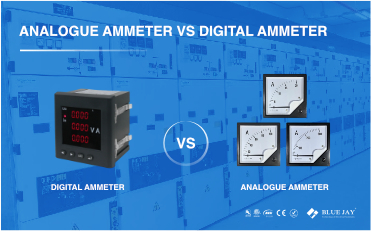
In power systems, industrial automation, and various power distribution and monitoring scenarios, current measurement is one of the most fundamental and critical electrical parameters. Ammeters, as the core instruments for current measurement, are mainly divided into two categories: Analogue Ammeters and Digital Ammeters.
Although both are used to measure current magnitude, they differ fundamentally in their working principles, measurement accuracy, functional expansion, and system adaptability. As modern power systems increasingly demand higher data accuracy and digitization, digital ammeters are gradually replacing traditional analog ammeters and becoming the mainstream choice.
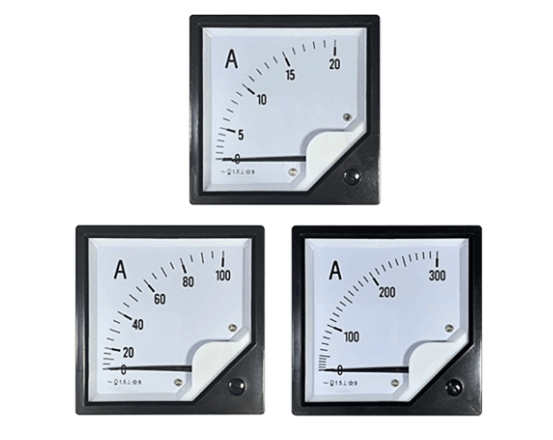
Analog ammeters are traditional current-measuring instruments based on electromagnetic deflection. When current flows through a moving coil within a magnetic field, an induced force causes the pointer to deflect proportionally, and the current value is read directly from the scale.
Their main advantages lie in intuitive visualization of current trends and a simple, robust structure. The continuous pointer movement allows quick perception of current fluctuations, and the absence of complex electronics makes them relatively stable in harsh electromagnetic environments with lower cost.
However, analog ammeters have clear limitations. Measurement accuracy is typically limited to ±1%–±2% due to mechanical inertia, scale resolution, and reading errors. They do not support data recording or communication, requiring manual reading, and their larger panel size makes multi-circuit monitoring and compact cabinet design more difficult.
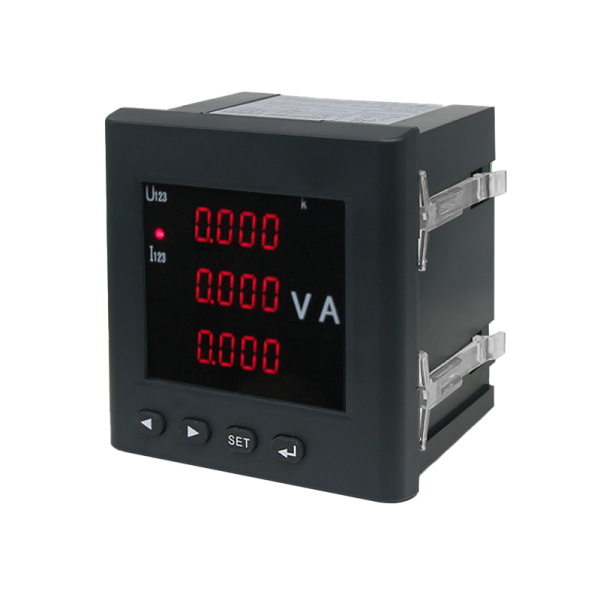
Digital ammeters utilize electronic measurement and digital processing technologies. They convert the measured current into a voltage or digital signal through methods such as shunts, Hall sensors, or current transformers. This signal is then sampled and processed by an ADC (Analog-to-Digital Converter), and the measurement result is finally displayed in digital form.
Taking the Blue Jay BPM2/3-96I digital ammeter as an example, this product is a standard 96×96 mm panel-mounted digital instrument suitable for AC single-phase/three-phase system measurements. It features high accuracy, clear display, and strong stability. The BPM2/3-96I not only provides a clear display of current values but also supports RS485/Modbus RTU communication, allowing for easy integration into PLCs, SCADA systems, or energy management systems for remote monitoring and centralized management.
| Analog ammeters | Digital ammeter | |
| Measurement Accuracy | Lower accuracy, typically ±1% to ±2% | High-precision design, measurement accuracy up to ±0.5% (IEC 61557-12 standard), using a 16-bit ADC chip and advanced signal processing algorithms. |
| Data Recording and Transmission | No automatic recording function; manual reading of records is required, and remote transmission is not possible. | Supports automatic data storage, equipped with an RS485 communication interface (2/3-wire half-duplex), compatible with Modbus RTU protocol, and can be seamlessly integrated with microcomputers and PLCs for remote monitoring. |
| Display effect | Pointer + dial display, relies on manual observation, easily affected by lighting and viewing angle. | Supports thousands/millions unit LED indication, high-brightness design, strong readability in various environments. |
| Functionality and Expandability | Only capable of measuring current, no additional expansion functions. | Supports current and voltage measurement, with optional expandable I/O modules and RS485 communication capabilities. |
| Maintenance Costs | Simple structure, low failure rate, but the scale is prone to wear and tear, the pointer is easily misaligned, and frequent calibration is required. | High integration of electronic components, low failure rate, supports parameter password protection to reduce misoperation, longer calibration cycle, and lower maintenance costs. |
| Applicable Scenarios | Traditional low-voltage circuits, scenarios with low precision requirements, and simple monitoring needs with limited budgets. | Industrial production, power systems, smart buildings, semiconductor manufacturing, and other scenarios requiring high precision, automation, and integration. |
In summary, although analog ammeters still have some value in specific scenarios, digital ammeters, represented by the Blue Jay BPM2/3-96I, offer significant advantages in terms of measurement accuracy, data recording and transmission, display readability, functional expandability, and installation space utilization. As power systems become increasingly intelligent and automated, digital ammeters will become the mainstream choice for current measurement.

Energy metering solutions extend far beyond billing; they are
Energy meter vs power meter is to help you
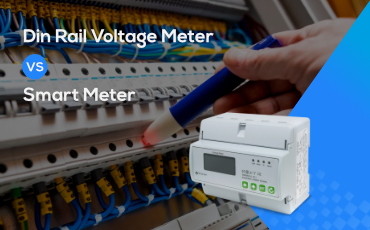
The din rail voltage meter and smart meter are