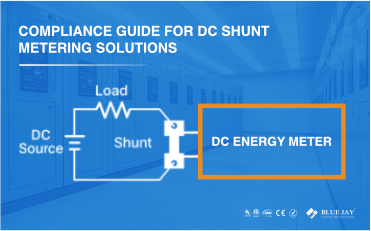
A DC shunt metering solution is a high-precision current sensing architecture based on the Ohm’s law voltage division principle. It primarily consists of a precision DC shunt and a DC energy meter working together. This solution aims to provide energy monitoring that meets billing-grade requirements for high-power DC infrastructure (such as electrochemical energy storage (BESS), electric vehicle DC fast charging stations, and data center DC power supply systems).
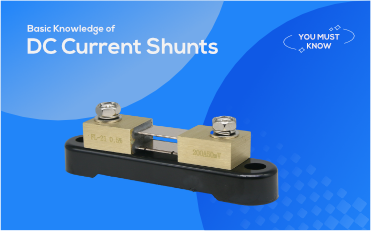
Physically, the DC shunt acts as a primary sensor connected in series with the main DC circuit. When a large current passes through its specially designed low-resistance alloy, it generates a millivolt-level voltage signal linearly proportional to the current (typically 50mV, 75mV, or 100mV).
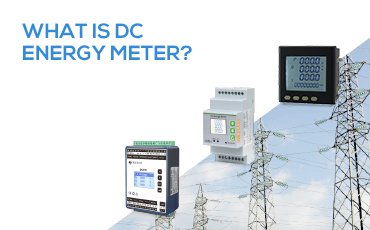
In the secondary processing stage, the DC energy meter captures this weak voltage drop through a high-impedance sampling channel and simultaneously monitors the system’s real-time voltage. A built-in high-speed digital signal processor (DSP) performs numerical calculations to achieve accurate conversion from the raw physical quantities to instantaneous current (A), real-time power (kW), and cumulative energy (kWh).
What application scenarios require DC shunt metering solutions?
DC shunt metering solutions are commonly used in applications requiring precise DC measurement, including:
Battery energy storage systems: Battery strings and BESS racks
DC connections in renewable energy: Solar power plants
DC connections in electric vehicle infrastructure: DC charging stations
DC busbars in DC data centers and industrial facilities
Telecommunications power systems and UPS rooms
DC motors
What are the mandatory compliance requirements for the DC shunt metering solution?
In a DC shunt metering system, the DC shunt and DC meter are essential components of the entire metering system. To ensure accurate metering and insulation safety, both the DC meter and the shunt must comply with AS/IEC standards, including IEC 62052-11, IEC 62053-41, and IEC 62052-31.
IEC 62052-11 specifies the general requirements for DC shunt metering systems, requiring DC meters to have a certain level of tolerance in real-world environments (temperature drift, electromagnetic interference).
IEC 62053-41 specifies that the accuracy class of the DC energy meter in the DC shunt metering system must meet class 0.5 or class 1 to ensure accurate storage and billing. Since the DC shunt is part of the metering system, this standard also applies to evaluating the compliance of the DC shunt’s accuracy.
IEC 62052-31 requires that the DC shunt metering system comply with safety regulations for fire protection, electric shock protection, and creepage distance for high-voltage DC (up to 1500V).
In summary, to ensure stable measurement data and system safety, the DC shunt metering system needs to comply with AS/IEC standards such as IEC 62052-11, IEC 62053-41, and IEC 62052-31. For the DC shunt in this system, we can also use AS/IEC standards to ensure that the shunt’s rating, accuracy, load voltage, and installation meet the input requirements of the meter and the overall system design.
DC shunt metering scheme vs. DC Hall sensor metering scheme
In the field of DC measurement, although both DC shunt measurement and DC Hall sensor measurement can be used for DC monitoring, there are some differences between the two.
Features
DC Shunt Measurement Scheme
DC Hall Sensor Measurement Solution
Working Principle
Ohm’s Law (direct voltage drop measurement)
Electromagnetic induction (measures the magnetic field generated by the current)
Accuracy (IEC 62053-41)
Easily achieves accuracy of 0.5 class or higher, with excellent long-term stability.
Affected by residual magnetism and hysteresis effects, typically Class 1.0 or lower accuracy.
Electrical Isolation (IEC 62052-31)
The shunt is directly connected in series in the circuit, requiring the isolated input section of the meter.
Non-contact measurement; the Hall sensor is physically isolated from the high-voltage busbar.
Installation
Installation is more difficult, requiring disconnecting the busbar or cable for series installation.
Easy installation; open-type Hall sensors can be directly fitted onto the cable without disconnecting the circuit.
Application Scenarios
Legal billing and energy auditing: Data centers, government-subsidized green energy projects, shared energy storage power stations.
“Suitable for: Existing line modifications: factories and substations that cannot afford power outage losses.
Conclusion
DC shunt metering provides a highly accurate and standards-compliant solution for DC energy measurement in high-power applications. By integrating a precision shunt with a DC energy meter, it delivers reliable billing-grade current and energy data while meeting key AS/IEC accuracy and safety requirements, making it ideal for revenue metering and critical DC infrastructure.
Chongqing Blue Jay Technology Co., Ltd. was founded by engineers with many years of experience. Focuses on the development, production and sales of power automation monitoring products and energy metering instruments.