Four insulation monitoring device circuit Solutions
Insulation monitoring device circuit solutions are essential for ensuring

With the continuous increase of photovoltaic (PV) system capacity and operating voltage, insulation monitoring has become a critical safety and availability requirement, especially in ungrounded (IT) or functionally ungrounded PV systems. Insulation Monitoring Devices (IMDs) are widely applied in PV installations to detect insulation degradation at an early stage, reduce the risk of electric shock and fire, and ensure long-term system reliability.
Depending on inverter topology and system architecture, the insulation monitoring strategy differs. Typical Insulation monitoring device for PV application is listed in the following:
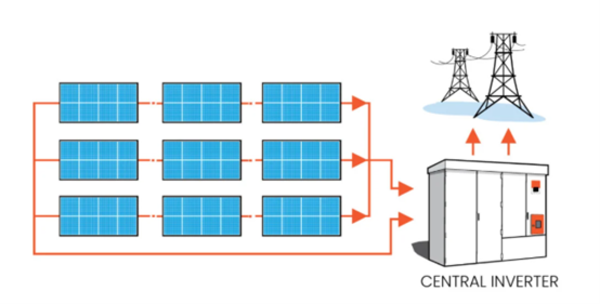
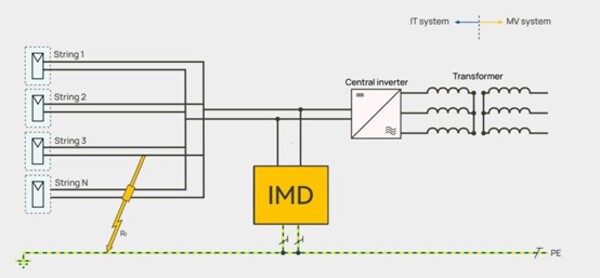
In centralized or distributed central inverter PV systems, multiple PV strings are combined and connected to a large-capacity inverter. These systems usually feature long DC cable routes, high system capacitance to earth, and operating voltages up to 1500 V DC.
In such installations, insulation monitoring is typically implemented at the DC bus level. A single IMD is sufficient to supervise the insulation resistance of the entire DC system, enabling early detection of insulation degradation caused by aging cables, connector failures, moisture ingress, or insulation damage within combiner boxes.
In distributed PV systems employing string inverters, each inverter is connected to a limited number of PV strings. This architecture improves system availability and reduces fault impact scope, but increases the number of monitored nodes.
Insulation monitoring in string inverter systems can be implemented either per inverter or per DC branch, depending on system requirements. IMDs ensure continuous supervision of the DC insulation resistance and help locate insulation faults before they develop into serious safety incidents or inverter shutdowns.
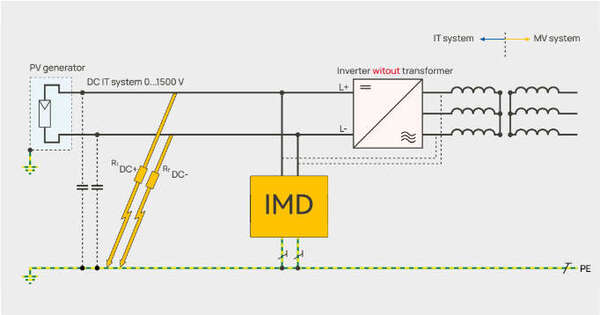
In Inverter PV Systems without transformer with a DC voltage range of 0–1500 V, the DC bus is directly coupled to the AC grid or load side through power electronic components, without galvanic isolation. As a result, the DC and AC circuits are electrically connected from an insulation monitoring perspective.
To continuously monitor the insulation condition of the entire 1500 V DC circuit and the associated AC circuit, only one signal-injection-based insulation monitoring device needs to be installed on the DC bus. The IMD injects a defined measurement signal into the system via DC+ or DC−. This signal propagates through the inverter and reaches the AC network.
If an insulation fault to earth occurs on the AC side, the injected signal flows through the earth path and returns to the grounding terminal of the IMD. Likewise, if an insulation fault occurs on the DC side, the injected signal flows from the fault point to earth and returns to the IMD via the protective earth conductor.
In summary, in transformerless PV systems, installing an IMD on either the DC side or the AC side (depending on project configuration) enables comprehensive insulation monitoring of both DC and AC circuits, providing full-system insulation supervision with minimal hardware complexity.
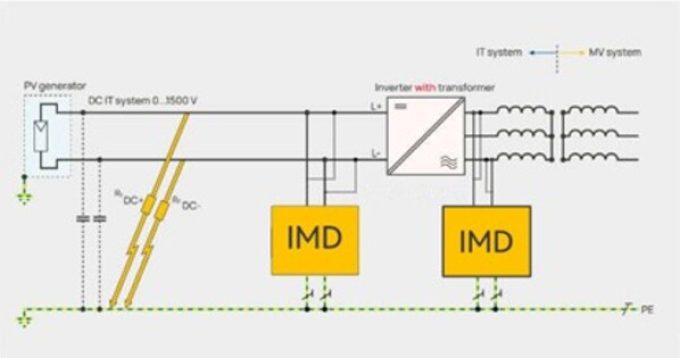
In PV systems with transformer-based inverters, the inverter output is integrated with or connected to an isolation transformer, providing galvanic separation between the DC side (PV array) and the AC side (grid). This isolation effectively prevents DC-side insulation faults from propagating directly into the AC network and enhances system safety.
In such systems, if an IMD is installed only on the DC side, insulation monitoring is limited to the section from the PV modules up to the primary side of the transformer. The isolation transformer blocks the measurement signal injected by the IMD, preventing it from reaching the AC side.
If users require insulation monitoring for the entire PV system, including both DC and AC circuits, separate IMDs must be installed on the DC side and the AC side respectively. This arrangement ensures comprehensive insulation supervision while maintaining the electrical isolation provided by the transformer.
The application of insulation monitoring devices in PV systems depends strongly on inverter topology and system grounding concept. Without transformer systems allow full DC and AC insulation supervision with a single IMD, while transformer-isolated systems require independent monitoring on both sides of the transformer. Selecting an appropriate insulation monitoring strategy is essential for ensuring electrical safety, fault detection capability, and long-term operational reliability of modern photovoltaic installations.

Insulation monitoring device circuit solutions are essential for ensuring
Want to know about a dual ev charger insulation
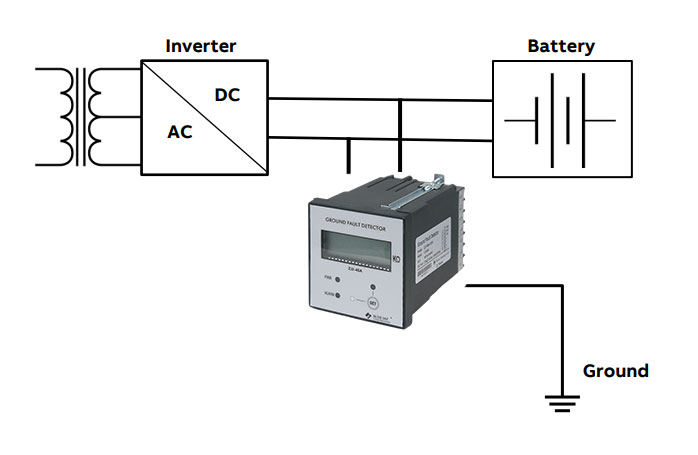
Battery energy storage systems (BESS) are typically ungrounded systems,