Arc Flash Relay Configuration for sectionalized single busbar system
What is sectionalized single busbar system? A segmented single

Why is arc flash tripping logic important for arc flash protection? Many arc flash incidents escalate not because the detectors fail to detect the arc flash, but because the protective relay doesn’t know which circuit breaker to trip. To help users achieve accurate fault tripping, this article will discuss three different tripping logics for arc flash relays: Zone Tripping, Upstream Breaker Tripping, and Tie Breaker Tripping.
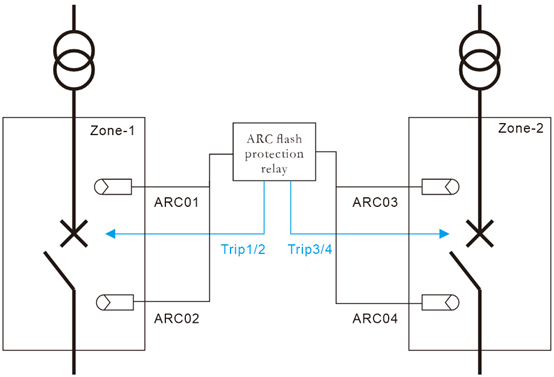
Zone tripping of arc flash relays refers to dividing the switchgear into different protection zones, such as the incoming line zone, busbar zone, and feeder zone. The arc flash relay only trips the circuit breaker in the zone where the arc flash occurs, without affecting the normal operation of other zones. For example, if an arc flash occurs only in the feeder zone of the switchgear, the arc flash relay will only send a trip signal to the feeder circuit breaker, tripping the feeder zone. Zone tripping of arc flash relays is commonly used in data centers, continuous process industries such as petrochemicals, hospitals and life safety systems, and low-voltage large-circuit incoming line cabinets.
Taking a data center as an example, the core requirement of the arc flash protection scheme is very clear: it must clear the fault in milliseconds, but it must not cause unnecessary tripping. This scenario requires an arc flash relay capable of zone tripping. By deploying independent arc flash sensors in the incoming line cabinet, busbar compartment, and feeder cabinet, and configuring a zone-tripping arc flash relay, when an arc flash sensor in any zone detects an arc flash, and the current transformer detects a sudden change in the current of that branch, the arc flash relay will only send a trip command to the circuit breaker in that zone.
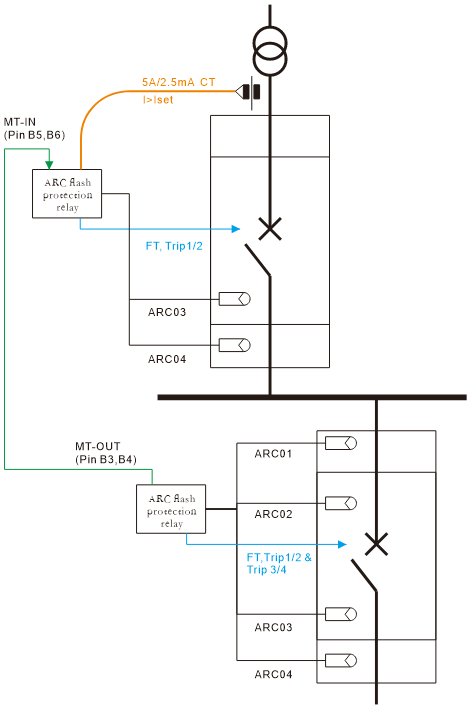
Upstream breaker tripping of arc flash relays means that regardless of whether the fault occurs on the busbar or incoming line side, or in the incoming line cabinet cable compartment, the arc flash relay will send a trip signal to the incoming line circuit breaker or the upstream outgoing switch, cutting off the main power supply. This arc flash protection tripping logic is commonly used for busbar compartment faults, internal faults in the incoming line cabinet, circuit breaker failure protection, and retrofitting of old equipment.
For example: If the local circuit breaker fails to open, the arc flash relay will send another trip command to the upstream circuit breaker after a short delay to clear the fault.
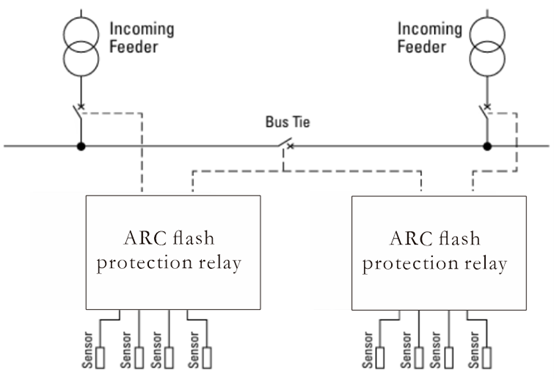
Tie breaker tripping of arc flash relays is typically applied in power systems operating with double busbars, interrupting the tie breaker switch between the busbars. When an arc flash fault occurs on busbar section I, the relay sends a trip signal to the incoming feeder and the bus tie breaker for section I. Tripping the bus tie breaker prevents power from being fed from busbar section II, thus protecting busbar section II and ensuring its continued normal operation. In this scenario, it is generally necessary to install an arc flash relay with tie breaker tripping functionality on each busbar section.
Different arc flash protection tripping logics serve different system requirements. Zonal tripping emphasizes precise fault isolation and system continuity, upstream circuit breaker tripping prioritizes rapid fault clearing, and bus tie breaker tripping is used in double busbar systems to prevent fault propagation. The rational application of these strategies achieves the optimal balance between personnel safety, equipment protection, and power supply reliability.

What is sectionalized single busbar system? A segmented single
Is there any difference between arc flash relays and

Arc flash mitigation methods, also called arc flash mitigation