Free cookie consent management tool by TermsFeed Update cookies preferences
Technology of Electrical Automatic

Arc flash Detection Solution for MV Marine Switchgear

Shipboard power distribution systems often operate in compact spaces where electrical equipment is installed close together. Combined with multiple power sources, interconnected bus sections, and changing power flow, these characteristics make internal arc faults a critical safety concern in medium-voltage (MV) marine switchgear.

An internal arc fault can release intense heat and pressure within a very short period, potentially damaging switchgear components, interrupting power supply, and endangering crew members.

To improve electrical safety, an arc flash protection relay can be installed in MV marine switchgear to detect internal arc faults and initiate rapid circuit breaker tripping. By combining optical arc detection with current monitoring, the protection system can identify configured arc fault conditions and help isolate the affected bus section, reducing the potential damage caused by an arc flash event.

This article explains why MV marine switchgear needs arc flash protection, how a marine arc flash detection system works, and how Blue Jay configured an AFR-M arc flash protection solution for an offshore wind installation vessel.

Arc flash Detection Solution for MV Marine Switchgear

Why Does MV Marine Switchgear Need Arc Flash Protection?

Marine medium-voltage power distribution systems have different operating characteristics from many conventional onshore distribution systems. Multiple generator feeders, interconnected bus sections, and flexible bus-tie connections allow the power supply to be adjusted according to operational requirements.

However, these characteristics also create additional considerations for internal arc fault protection.

Multiple Power Sources and Flexible Power Distribution

Shipboard MV power systems commonly use multiple generators to supply electrical loads. Generator incomers and bus-tie circuit breakers allow different bus sections to operate independently or in an interconnected configuration.

Depending on the operating condition and switching arrangement, current can flow through different feeders and bus sections.

If an internal arc fault occurs in a busbar compartment, the fault may receive energy from more than one connected power source. Therefore, the protection scheme needs to consider the generator incomers, bus-tie connections, and possible power supply paths when determining which circuit breakers should trip.

Compact Switchgear Layouts

Marine switchboards are generally designed to make efficient use of limited installation space. Electrical components and switchgear compartments are often arranged within a relatively compact area.

An internal arc fault can cause severe thermal and mechanical damage to the affected compartment and potentially affect adjacent equipment.

Harsh Marine Operating Conditions

Shipboard electrical equipment may be exposed to vibration, humidity, temperature variations, and other environmental stresses.

These conditions can contribute to insulation deterioration, electrical connection problems, and other faults if equipment is not properly designed, installed, and maintained.

Consequences of Internal Arc Faults

An internal arc fault in MV marine switchgear may result in:

  • Severe thermal damage to busbars, cables, and switchgear components.
  • Pressure buildup and mechanical damage inside switchgear compartments.
  • Damage to adjacent electrical equipment.
  • Unexpected interruption of power supply to critical shipboard loads.
  • Safety risks to crew members and maintenance personnel.
  • Costly repairs and extended vessel or offshore platform downtime.
  • Installing an arc flash protection relay helps detect configured internal arc fault conditions and initiate protective tripping before the fault causes more extensive damage.

How Does an Arc Flash Protection Relay Work in MV Marine Switchgear?

An arc flash protection relay uses optical sensors to detect light generated by an internal electrical arc. It can also monitor electrical current to verify the detected fault condition.

In an optical and current-based protection scheme, the relay evaluates the arc signal together with the configured current-increase criterion before initiating a trip command.

Optical Arc Detection

Optical arc sensors are installed in designated compartments of the medium-voltage switchgear, such as busbar compartments.

When an internal arc occurs, the resulting intense light is detected by the optical sensor and transmitted to the main arc flash protection relay through an optical fiber connection.

This allows the protection system to identify the location or zone where an arc signal has been detected, depending on the sensor arrangement and relay configuration.

Current Monitoring and Arc Fault Verification

In addition to optical detection, current transformers (CTs) provide three-phase current signals from the generator incomers and bus-tie feeders.

The arc flash protection relay monitors changes in these current signals.

When the relay receives an optical arc signal, it evaluates the corresponding current increase according to the configured protection settings.

Combining optical detection with current monitoring provides an additional verification criterion for identifying internal arc fault conditions and helps reduce the risk of unnecessary tripping caused by light-only events.

Circuit Breaker Tripping and Fault Isolation

When the configured arc and current protection conditions are satisfied, the relay sends trip commands to the relevant circuit breakers.

In a sectionalized marine MV switchboard, the protection logic can be configured to isolate the affected bus section by tripping the corresponding generator incomer and bus-tie circuit breakers.

The actual tripping arrangement should be determined according to the single-line diagram, bus-tie operating status, possible fault current supply paths, and the overall protection coordination scheme.

Why Is Busbar Section Protection Important?

For marine power systems with multiple generators and interconnected bus sections, identifying the affected bus section is essential.

A properly configured sectionalized arc protection scheme helps:

  • Monitor internal arc faults in different busbar sections independently.
    Associate optical arc signals with the relevant current measurement channels.
  • Identify the affected protection zone.
  • Trip the appropriate circuit breakers to isolate the faulted section.
  • Minimize unnecessary interruption to healthy sections of the power system.

Blue Jay Arc Flash Protection Solution for MV Marine Switchgear

Client Project Background: Offshore Wind Installation Vessel

A shipping company’s offshore wind installation platform has three medium-voltage distribution boards, divided into three bus sections: A, B, and C.

Each section is supplied by two generator incomers and interconnected through bus-tie feeders.

The switchboard configuration is as follows:

Bus SectionGenerator IncomersBus-Tie Feeders
A21
B22
C21
Total64

The client required an arc flash protection system to monitor the busbar compartments of the switchgear cabinets and detect internal arc faults in each bus section.

The system also needed to monitor the three-phase currents of the generator incomers and bus-tie feeders to support the arc fault protection logic.

Arc Flash Protection System Configuration

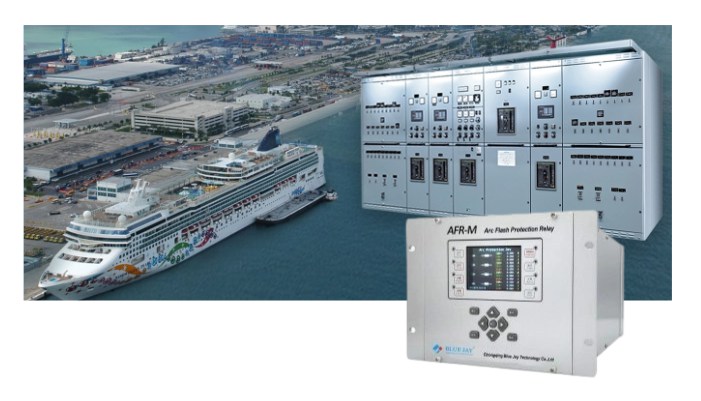
Based on the client’s switchboard configuration, Blue Jay selected the AFR-M busbar arc flash protection relay. The AFR-M supports four groups of three-phase current measurement and multiple arc sensor inputs, making it suitable for this project’s monitoring requirements. The required configuration for each bus section is:
  • Two groups of three-phase current measurement for the two generator incomers.
  • One group of three-phase current measurement for the A-section bus-tie feeder.
  • Two groups of three-phase current measurement for the two B-section bus-tie feeders.
  • One group of three-phase current measurement for the C-section bus-tie feeder.
  • Optical arc monitoring for the designated busbar compartments of each switchgear cabinet.
Because each bus section requires no more than four groups of three-phase current measurement, one AFR-M relay can handle the current monitoring requirements of each section. The final protection configuration is as follows:
Bus Section Current Measurement Groups AFR-M Relay Arc Sensor Arrangement
A 3 1 One sensor in each designated busbar compartment
B 4 1 One sensor in each designated busbar compartment
C 3 1 One sensor in each designated busbar compartment
Total 10 3 According to the monitored compartments
Therefore, the project uses three AFR-M arc flash protection relays, with one main unit assigned to each bus section. An optical arc sensor is installed in the busbar compartment of each monitored switchgear cabinet. This arrangement provides independent arc fault monitoring for the three bus sections while integrating the generator incomer and bus-tie current signals into the corresponding protection units.

AFR-M Busbar Arc Flash Protection Relay

The AFR-M is designed for busbar arc fault detection and protection in medium-voltage switchgear. Key product features include:
  • Multiple optical arc sensor inputs for monitoring designated switchgear compartments.
  • Three-phase current measurement for arc fault verification.
  • Configurable upstream circuit breaker, zone, and bus-tie breaker tripping.
  • Flexible protection logic for different busbar configurations.
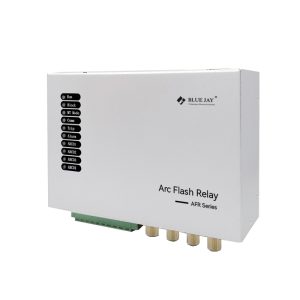
AFR-M arc flash protection for switchgear

Blue Jay AFR-M Busbar Arc Flash Relay

up to 48 channels for arc sensors

High accuracy Current & light sensing

Upstream circuit breaker tripping, Zone & Tie breaker tripping

Arc Fault Detection and Circuit Breaker Tripping Logic

The protection logic for this offshore wind installation vessel is based on optical arc detection combined with current-increase monitoring.

The operating sequence is as follows:

Step 1: Arc Signal Detection

The ARB5-S-style optical arc sensing arrangement (using the project’s specified arc probes) detects light generated by an internal arc fault in the busbar compartment.

Step 2: Optical Signal Transmission

The detected arc signal is transmitted to the corresponding AFR-M main unit through the optical fiber connection.

Step 3: Current Signal Verification

The AFR-M evaluates the detected arc signal together with the current increase measured from the associated generator incomer or bus-tie feeder.

Step 4: Circuit Breaker Tripping

When the configured protection conditions are satisfied, the AFR-M sends trip commands to the corresponding generator incomer and bus-tie circuit breakers to isolate the affected bus section.

This protection arrangement allows each bus section to have its own arc detection and current monitoring unit, helping the system respond to internal arc faults according to the designed protection matrix.

Additional Advantages of Blue Jay's Marine Arc Flash Protection Solution

In addition to optical arc detection and current monitoring, the AFR-M provides communication and control functions that support integration into marine electrical monitoring and protection systems. Dual Communication Interfaces RS485 and Ethernet communication interfaces support integration with existing monitoring systems. The relay supports Modbus and IEC 60870-5-103 communication protocols. Flexible Relay Outputs Nine independent relay outputs allow flexible configuration of trip, alarm, locking, and other control functions according to project requirements. Wide Auxiliary Power Supply Range The AC/DC 85–265 V auxiliary power input provides flexibility when integrating the relay into different shipboard control power arrangements. EMC Performance The relay is designed with electromagnetic compatibility protection and complies with the applicable GB/T 14598 series requirements, subject to the relevant product test documentation. These features help make the AFR-M a flexible arc flash protection solution for medium-voltage marine switchboards.

What Should You Consider When Selecting an Arc Flash Protection Relay for MV Marine Switchgear?

Selecting an arc flash protection relay requires more than checking its number of optical sensor inputs. The protection system must match the switchboard configuration and the electrical characteristics of the vessel. Consider the following factors:

Number of Arc Flash Sensor Inputs

Determine how many switchgear compartments need to be monitored. The relay must provide sufficient optical sensor inputs for the planned installation, including the required protection zones and any future expansion requirements.

Three-Phase Current Monitoring Capability

Check the number of three-phase current measurement groups supported by the relay.

For systems with multiple generator incomers and bus-tie feeders, the relay must have sufficient current inputs to implement the intended arc and current verification logic.

Arc Sensor Installation and Coverage

Determine the appropriate optical sensor locations according to the internal structure of the switchgear. Common monitoring locations may include:
  • Busbar compartments.
  • Circuit breaker compartments.
  • Cable compartments.
The actual sensor arrangement should consider compartment geometry, optical coverage, installation restrictions, and the manufacturer’s installation instructions.

Busbar Section Protection and Trip Logic

For sectionalized marine power systems, verify that the relay can implement the required protection zones and circuit breaker tripping arrangements.

The protection design should consider:

  • Generator incomer configurations.
  • Bus-tie breaker positions.
  • Normal and interconnected bus operating modes.
  • Possible fault current supply paths.
  • Coordination with upstream and downstream protection devices.

Communication and Environmental Compatibility

Check whether the relay supports the communication protocols required by the vessel’s power monitoring system.

Also verify auxiliary power supply requirements, electromagnetic compatibility, temperature range, vibration resistance, and any required marine type approval or classification society certification.

Why Choose Blue Jay Arc Flash Protection for MV Marine Switchgear?

Blue Jay Technolgoy provides arc flash protection relays and optical arc detection solutions for medium-voltage switchgear applications. Our AFR-M arc flash protection relay offers several features for marine switchboard projects:
  • Multi-channel arc detection: Monitors multiple designated switchgear compartments through optical arc sensors.
  • Optical and current-based protection: Combines arc detection with current monitoring for configured fault verification.
  • Flexible busbar protection: Supports different generator incomer and bus-tie configurations.
  • System integration: Provides RS485 and Ethernet communication for integration with existing electrical monitoring systems.
  • Application-specific configuration: Supports protection arrangements based on switchboard layouts, current measurement requirements, and circuit breaker trip logic.
Whether you are a marine switchgear manufacturer, ship electrical system integrator, or offshore platform contractor, Blue Jay can provide an arc flash protection solution based on your medium-voltage switchboard configuration.

Frequently Asked Questions About Marine MV Switchgear Arc Flash Protection

Can an Arc Flash Protection Relay Be Installed in Existing Marine MV Switchgear?

Yes. An arc flash protection relay can be considered for retrofit projects, provided that the existing switchgear has suitable sensor installation locations, compatible current measurement signals, auxiliary power, and circuit breaker trip interfaces.

The existing switchboard drawings and protection arrangements should be reviewed before installation.

How Many Arc Sensors Are Needed for an MV Marine Switchboard?

The number of arc flash sensors depends on the number of compartments requiring monitoring and the protection coverage specified in the project design.

For example, if each monitored busbar compartment requires one optical arc sensor, the total number of sensors will depend on the number of such compartments.

Can One Arc Flash Relay Protect Multiple Busbar Sections?

This depends on the relay’s current measurement capacity, optical sensor inputs, protection zoning, and trip output configuration.

For the offshore wind installation vessel described in this case study, three AFR-M relays were used, with one relay assigned to each of the three bus sections.

Does Marine Arc Flash Protection Work with Multiple Generator Incomers?

Yes. Arc flash protection systems can be configured for switchboards with multiple generator incomers.

The protection design needs to consider the current measurement signals, bus-tie connections, possible power supply paths, and the required circuit breaker tripping sequence.

What Is the Difference Between Internal Arc Classification and Arc Flash Protection?

Internal arc classification evaluates the performance of switchgear under specified internal arc test conditions, such as those covered by IEC 62271-200.

Arc flash protection, on the other hand, uses optical sensors and protection relays to detect configured internal arc fault conditions and initiate circuit breaker tripping.

They are complementary but different aspects of electrical safety. Installing an arc flash protection relay does not automatically give switchgear an internal arc classification.

Conclusion: Arc Flash Protection for Safer Marine MV Power Distribution

Internal arc faults in marine medium-voltage switchgear can cause serious equipment damage, power interruptions, and safety risks to crew members.

An effective arc flash protection scheme should combine optical arc detection, current monitoring, appropriate protection zoning, and coordinated circuit breaker tripping.

As demonstrated by the offshore wind installation vessel project, Blue Jay’s AFR-M arc flash protection relay provides a flexible solution for monitoring multiple busbar sections and implementing application-specific arc fault protection.

Looking for an Arc Flash Protection Solution for Your Marine MV Switchgear?

Send your single-line diagram, switchboard layout, and current monitoring requirements to Blue Jay. Our team can help evaluate the required arc flash relays, optical sensors, and circuit breaker protection arrangements.

Related Relay for MV Marine Switchgear