
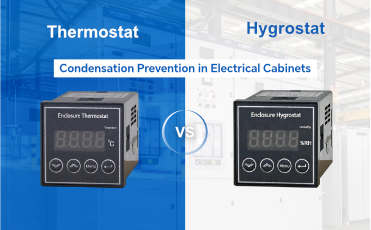
Thermostat vs Hygrostat for Condensation Prevention in Electrical Cabinets
Why Is Condensation a Problem in Electrical Cabinets?
Condensation occurs when water vapor in the air comes into contact with surfaces below the dew point, forming liquid water on enclosure walls, busbars, and electrical components. Common causes include day-night temperature fluctuations, moisture entering through door gaps and cable openings, and inadequate enclosure sealing.
Changes in temperature also affect relative humidity: when temperature drops, RH rises even if the actual moisture content remains unchanged. Once a surface temperature falls to or below the dew point, condensation can form.
Preventing condensation is essential to maintaining electrical safety and equipment reliability. Moisture can reduce insulation resistance, increase the risk of leakage currents, tracking and flashover, and accelerate corrosion of terminals, busbars, and electrical contacts. Prolonged exposure to moisture may also cause protection devices and electronic components to malfunction, shorten equipment service life, and increase the risk of electrical failure.
What Is a Thermostat and How Does It Prevent Condensation?
A thermostat is a temperature-sensitive controller that monitors the temperature inside an electrical enclosure and switches connected equipment according to preset thresholds. For condensation prevention, it typically controls a cabinet heater to raise internal temperature and keep component surfaces above the dew point.
How Does an Electrical Cabinet Thermostat Work?
A thermostat uses a temperature-sensing element and switching contacts. When the temperature falls below the heating setpoint, the contacts close and activate the heater. When the temperature rises to the upper threshold, the contacts open and switch it off. Hysteresis prevents frequent switching.
How Does a Thermostat Control a Cabinet Heater?
The thermostat continuously monitors internal air temperature and automatically switches the heater on or off according to the preset temperature range. By maintaining a suitable temperature, the heater reduces relative humidity and helps prevent moisture from condensing on electrical components.
Advantages and Limitations of Thermostat-Based Condensation Control
Advantages:
- Simple operation and installation.
- Effective against condensation caused by low temperatures.
- Helps maintain suitable operating temperatures and prevent frost.
Limitations:
- Responds to temperature, not humidity.
- Heating reduces relative humidity but does not remove moisture.
- May be insufficient in persistently humid environments.
What Is a Hygrostat and How Does It Prevent Condensation?
A hygrostat is a humidity-sensitive controller that monitors relative humidity (RH) inside an electrical enclosure and switches connected equipment according to preset thresholds. In cabinet climate control, it is commonly used to control ventilation fans to help manage internal humidity.
How Does an Electrical Cabinet Hygrostat Work?
A hygrostat uses a humidity sensor to detect changes in RH. When humidity exceeds the preset threshold, its relay output activates the connected equipment. When humidity drops below the stop threshold, the output switches off. Hysteresis helps prevent frequent switching.
How Does a Hygrostat Control a Cabinet Heater?
When the hygrostat detects high humidity, it energises the heater. Raising the air temperature increases its moisture-holding capacity, which lowers relative humidity even though the absolute moisture content is unchanged. Once RH drops below the stop point, the heater switches off.
Advantages and Limitations of Hygrostat-Based Condensation Control
Advantages:
- Responds directly to changes in cabinet humidity.
- Automatically controls ventilation according to preset humidity thresholds.
- Helps manage moisture in suitable environmental conditions.
Limitations:
- Does not independently remove moisture from the air.
- Ventilation may introduce additional moisture when outside air is humid.
- Does not directly measure component surface temperature or dew point.
Thermostat vs Hygrostat: What is the Difference for Condensation Control?
What Does Each Controller Measure? Temperature vs. Relative Humidity
A thermostat measures cabinet temperature, while a hygrostat measures relative humidity. Both parameters affect condensation risk, but they respond to different environmental conditions.
Item | Thermostat | Hygrostat |
Measured parameter | Temperature (°C) | Relative humidity (% RH) |
Control condition | Temperature threshold | Humidity threshold |
Typical controlled load | Heater | Ventilation fan |
Main purpose | Temperature regulation | Humidity-based ventilation |
Differences in Operating Principles
A thermostat controls a heater according to temperature changes, helping keep cabinet surfaces above the dew point. A hygrostat controls a fan according to humidity changes, helping regulate cabinet air through ventilation.
Energy Consumption: How Do Control Settings Affect Heater Runtime?
A thermostat activates the heater when temperature falls below its setpoint. A hygrostat activates the fan when humidity exceeds its setpoint. Appropriate thresholds and hysteresis help reduce unnecessary operation and energy consumption.
Differences in Condensation Prevention Applications
Thermostats are suitable when low temperatures are the main condensation risk. Hygrostats are more suitable when humidity-based ventilation is required. Both functions can work together to provide more comprehensive cabinet climate control.
When Should You Use a Thermostat or a Hygrostat?
When to Use a Thermostat for Electrical Cabinets
Choose a thermostat when low temperatures, overnight cooling, or frost are the main concerns. It is suitable for applications requiring automatic heater control.
When to Use a Hygrostat for Electrical Cabinets
Choose a hygrostat when cabinet humidity is the main concern and ventilation can help regulate moisture levels.
When a Thermo-Hygrostat (Combined Controller) Is the Better Choice
Choose a combined controller when both temperature and humidity need to be monitored and controlled. The Blue Jay WSK series integrates both functions, with configurable inputs and relay outputs for temperature and humidity control.
How to Choose the Right Controller for Your Electrical Cabinet?
Step 1 — Identify the Main Condensation Risk
Determine whether condensation is mainly caused by low temperatures, high humidity, or both. This helps identify the required control function.
Step 2 — Check Temperature and Humidity Conditions
Evaluate typical and extreme cabinet temperature and humidity throughout the year. Consider dew point, frost protection, and equipment operating limits.
Step 3 — Select the Appropriate Controller and Controlled Equipment
Choose temperature control for heater operation and humidity control for ventilation fan operation. If both are required, consider a combined controller such as the Blue Jay WSK series.
Step 4 — Check Control Range, Contact Rating, and Installation Requirements
Before ordering, check:
- Control range: Covers the required temperature and humidity ranges.
- Setpoint and hysteresis: Meet the application requirements.
- Contact rating: Matches the connected heater or fan load.
Frequently Asked Questions
Can a Thermostat Prevent Condensation in Electrical Cabinets?
Yes. By maintaining cabinet temperature above the dew point, a thermostat helps prevent condensation. However, it does not remove moisture.
Is a Hygrostat Better Than a Thermostat for Condensation Prevention?
Neither is universally better. A thermostat responds to temperature, while a hygrostat responds to humidity. The choice depends on the main condensation risk.
Can a Hygrostat Replace an Electrical Cabinet Thermostat?
No. A hygrostat controls equipment according to humidity, while a thermostat controls equipment according to temperature. They perform different functions.
Does a Hygrostat Actually Remove Moisture From the Air?
No. A hygrostat is a controller, not a dehumidification device. It can operate a fan to regulate cabinet air through ventilation.
Can a Thermostat and Hygrostat Work Together?
Yes. They can independently control a heater and a ventilation fan. The Blue Jay WSK series integrates both control functions in one device.
What Is the Difference Between a Hygrostat and a Hygrotherm?
A hygrostat monitors and controls humidity, while a hygrotherm (thermo-hygrostat) combines temperature and humidity monitoring and control.