
Capacitance and Voltage on IMD Insulation Resistance Accuracy
What Does an IMD Actually Measure?
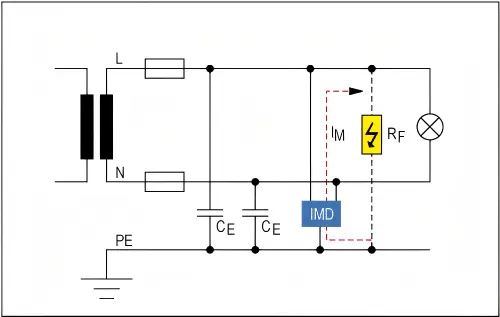
An insulation monitoring device (IMD) is designed to measure the insulation resistance of an unearthed (IT) electrical system. In principle, the IMD determines insulation resistance by injecting a known measurement voltage or current signal into the system and evaluating the resulting response. In practice, however, the IMD does not measure insulation resistance alone: it measures the total impedance of the system to earth, which comprises both the insulation resistance (the resistive component) and the system leakage capacitance (the reactive component). Every electrical system has an inherent leakage capacitance to earth, arising from the parasitic capacitance between conductors and earthed metallic structures, cable capacitance, motor winding capacitance and filter capacitance in connected equipment.
This capacitance appears in parallel with the insulation resistance and influences the measurement process. When the IMD injects its test signal, the current that flows is the vector sum of the resistive leakage current through the insulation resistance and the capacitive leakage current through the system capacitance. The IMD must separate the two components mathematically in order to determine the true insulation resistance. That separation takes time, because the capacitive component has to be characterised and subtracted from the total measured impedance.
Bus Voltage Effect on Measurement
The system bus voltage has a marked effect on the accuracy and stability of IMD insulation resistance measurements. When the bus voltage is within the normal operating range of the electrical system, the voltage is stable and predictable and its contribution to the total leakage current can be accounted for accurately by the IMD; under these conditions the measurement is reliable and repeatable. When the bus voltage approaches the upper or lower limits of the operating range, however, several effects can compromise accuracy. At very high bus voltages, non-linear insulation behaviour may become apparent: insulation materials that are essentially ohmic at normal voltage can exhibit voltage-dependent leakage currents at elevated voltage, causing the IMD to under-report the actual insulation resistance.
At very low bus voltages, the signal-to-noise ratio of the measurement deteriorates, because the measurement signal becomes small relative to background electrical noise, harmonics and transient disturbances on the bus, and the IMD may produce unstable or fluctuating readings. In addition, rapid voltage fluctuations on the bus, such as those caused by load switching or capacitor bank operations, can introduce transient currents that the IMD may misinterpret as a change in insulation resistance.
System Leakage Capacitance Effect
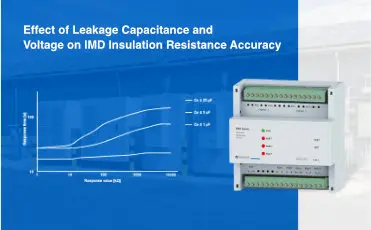
The system leakage capacitance (Ce) is arguably the most significant factor affecting both the accuracy and the speed of IMD measurement. The relationship between Ce and measurement behaviour is straightforward: in systems with low Ce the capacitive component of the total impedance is small and can be characterised and subtracted quickly, so the insulation resistance reading stabilises within seconds and an accurate, timely result is obtained. Systems with high Ce present a substantial challenge: the large capacitive component means that the IMD must inject its measurement signal for a longer period in order to charge the system capacitance fully and separate the resistive and capacitive components accurately.
During this charging period the displayed insulation resistance changes gradually as the capacitive transient decays, and only once the capacitive component has been fully characterised can the IMD report the true insulation resistance. In extreme cases, systems with very high Ce, such as large industrial installations with extensive cabling, numerous motors or substantial filtering capacitance, may require minutes or longer for the reading to stabilise. Throughout this stabilisation period the displayed value should be regarded as provisional and may not reflect the true insulation condition.
Why Measurement Time Varies
The time an IMD requires to produce an accurate insulation resistance reading is not a fixed value; it depends on several interacting factors, including the bus voltage, the system leakage capacitance, the level of electrical noise and harmonics present, and the measurement method the IMD employs. Different IMD designs use different approaches: DC injection, low-frequency AC injection or pulse injection. Each method has a different sensitivity to system capacitance and noise. DC injection methods, for example, are generally slower in high-Ce systems because they rely on the natural decay of the capacitive charging current, which is time-dependent.
Low-frequency AC injection can be faster but may be more susceptible to noise at the injection frequency. Measurement time is also influenced by the quality of the insulation itself: a system with very high insulation resistance may take longer to measure than one with lower resistance, because the resistive component is small relative to the capacitive component and separation is therefore more difficult. Recognising that measurement time is variable and system-dependent is essential for interpreting IMD readings correctly and for avoiding premature conclusions about insulation health.
Conclusion
The accuracy and speed of IMD insulation resistance measurements are governed by a complex interaction of system bus voltage, leakage capacitance, electrical noise and the measurement methodology employed by the device. Systems with low leakage capacitance and a stable bus voltage allow fast, accurate measurement, whereas systems with high capacitance or fluctuating voltage may require extended measurement times and may display interim readings that do not reflect the true insulation condition. Understanding these effects allows electrical engineers to interpret IMD readings correctly, to set appropriate alarm thresholds and time delays, and to design IT system installations that support accurate insulation monitoring. This knowledge is essential for maintaining the safety and reliability of unearthed electrical systems in critical applications.