
Smart DC Power Meter for EV Charging
DC energy meters are the core metering components of DC charging piles, directly determining billing accuracy, operational stability, and project compliance. With the widespread adoption of high-power fast-charging and ultra-fast charging technologies, DC meters have undergone multiple rounds of technical iteration, evolving from early, outdated models into the two mainstream solutions used today: the split-type (with external shunt) and the integrated-type (with internal shunt).
This article outlines the characteristics and pros and cons of four types of DC charging pile meters, provides an in-depth comparison of the core differences between split-type and integrated-type meters, and offers practical selection recommendations for dual-gun DC charging piles to help contractors, equipment manufacturers, and system integrators precisely match project requirements.
Four Types of DC Energy Meters for Charging Piles
Embedded DC energy meters—also known as panel-mount DC meters—require a custom cutout in the charging pile’s panel for installation. The installation process is complex, the requirements for the pile’s housing structure are stringent, and equipment compatibility is extremely poor. Due to their lack of flexibility, difficulty in retrofitting, and incompatibility with standardized mass-produced charging piles, these models have long been phased out by the industry and are not used in any new projects.
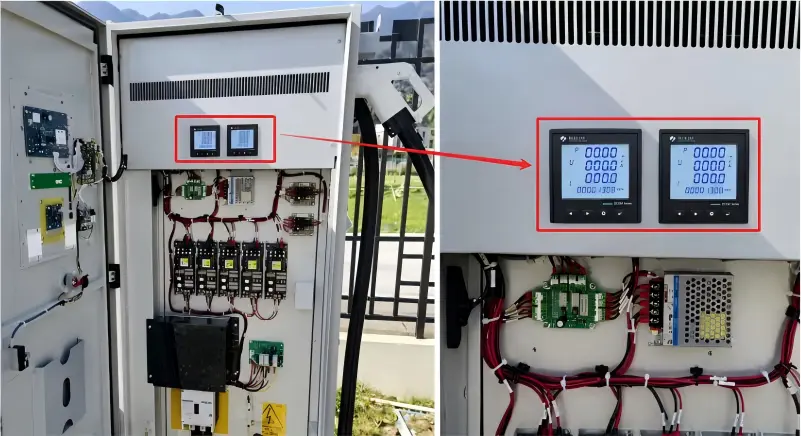
Wall-mounted DC energy meters represent the first generation of DC metering equipment in the industry. They utilize the housing of traditional AC meters—with manufacturers simply upgrading the internal metering chips and terminals to enable DC metering—and gained early popularity due to their low cost. However, their bulky size and significant footprint within the cabinet make them unsuitable for modern charging piles, which are trending toward compact designs and higher power outputs. They have largely been replaced by newer meter types and are now used only for retrofitting older charging piles.
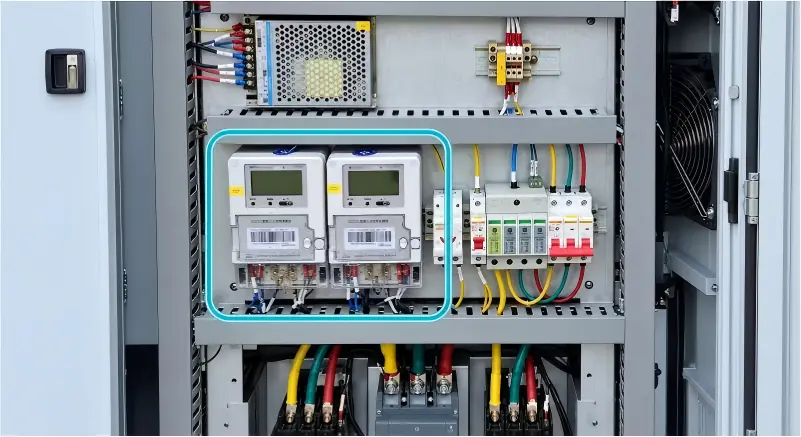
DIN-rail DC energy meters—also known as external-shunt or split-type DC meters—are an upgraded version of wall-mounted models and currently represent the mainstream, cost-effective choice in the market. Designed for standard 35mm DIN-rail mounting, they are approximately 40% smaller than wall-mounted models and can be directly installed inside the charging pile’s control cabinet, offering installation flexibility and space savings. Key features include support for dual-circuit designs, utilizing two external 75mV…” This shunt-based solution enables independent metering for dual-gun charging piles without the need for additional electricity meters, making it a perfect fit for standard dual-gun fast-charging scenarios. Featuring mature technology and low costs, it is widely used in entry-level to mid-range commercial fast-charging pile projects.
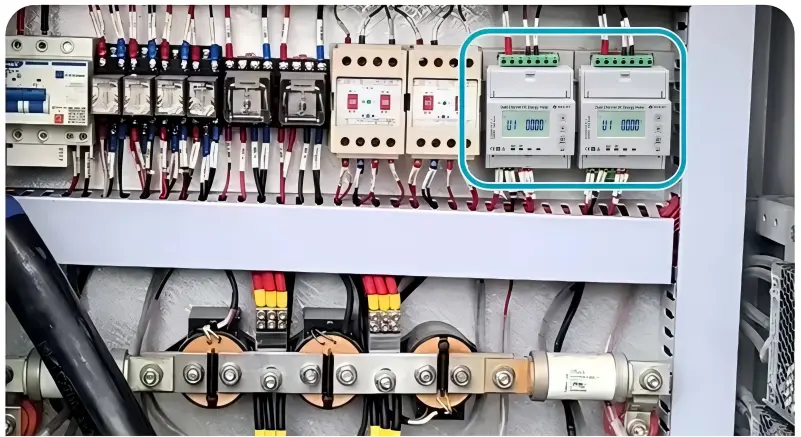
The integrated shunt DC energy meter—also known as a DC energy meter with a built-in shunt—is the mainstream high-end standard for fast-charging piles, ultra-fast charging piles, and OEM-supplied charging units. It represents the most technologically mature and stable metering solution available today. This product revolutionizes traditional split-component designs by highly integrating the current-sensing shunt with the meter’s mainboard, allowing the entire unit to be sealed. It fundamentally eliminates common issues associated with split-component devices, such as matching errors, loose wiring, signal instability, and tampering.
Additionally, these integrated DC energy meters support various wiring configurations—including three-wire, four-wire, and five-wire systems—offering exceptional versatility for applications ranging from standard fast charging and high-power ultra-fast charging to high-precision, low-loss metering.
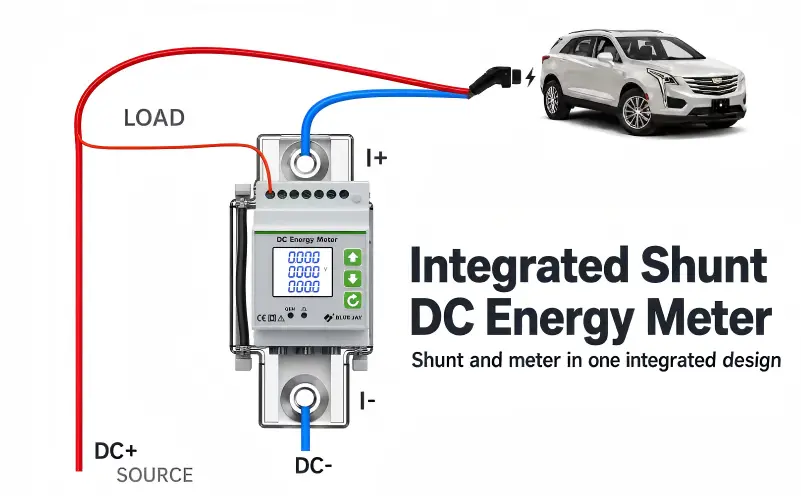
As shown in the figure, the two blue wires at the top and bottom are for current sensing, while the wire connecting the meter terminal to the red positive terminal is for voltage sensing. This totals three wires: two for current sensing and one for voltage sensing.
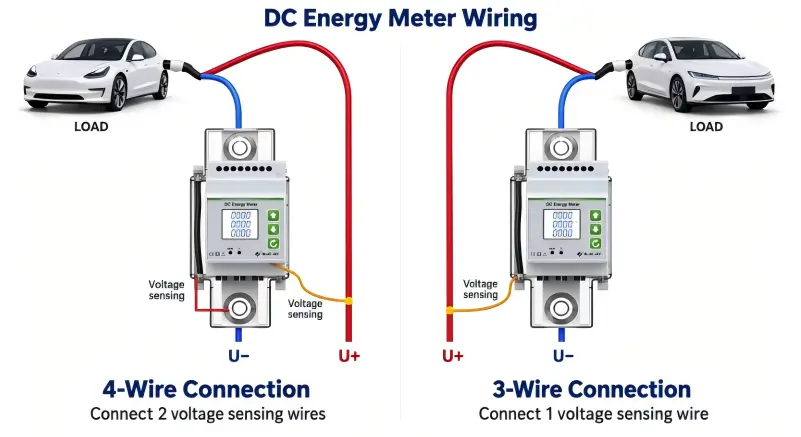
Compared to the three-wire system, the four-wire system includes an additional voltage sensing wire, totaling four wires: two for current sensing and two for voltage sensing. The user is required to connect this extra voltage sensing wire manually. This additional connection increases installation complexity and time, as well as material usage. To simplify installation, some manufacturers route this wire directly from the shunt terminal to the meter’s PCB mainboard.
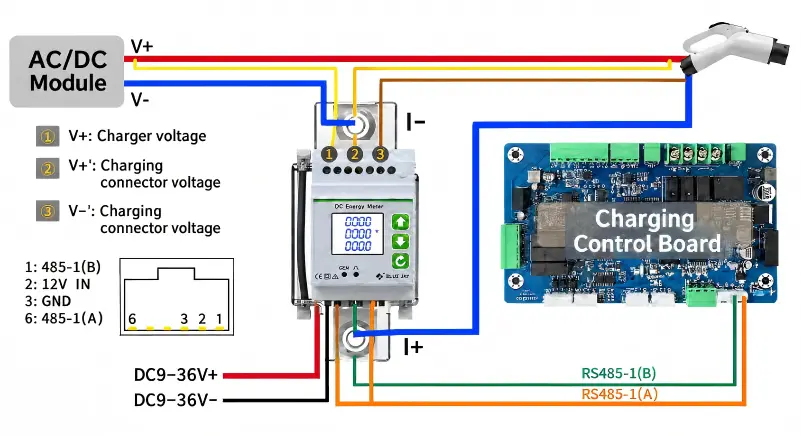
As shown in the figure, the two blue wires on the energy meter are for current sensing, while there are three voltage sensing wires: one for pile voltage sensing (charging pile output voltage) and two… Charging gun voltage sensing line (voltage at the charging gun/vehicle end). The five-wire configuration allows for measuring not only the energy from the pile (total energy output by the charging pile) but also the energy actually delivered to the vehicle—excluding cable losses.
Key Differences: DC Meters with External vs. Internal Shunts
The shunt is a core component of a DC energy meter; its resistance, material, and structural design directly determine the meter’s heat generation, power consumption, accuracy, and long-term stability. This is also the primary distinction between the two mainstream types of meters.
- Differences in Heat Generation and Power Consumption
Split-type meters with external shunts typically utilize a 75mV high-resistance design, resulting in high resistance, high power consumption, and significant heat generation.
Under standard 300A operating conditions, the power consumption of a split-type meter can reach 22.5VA; prolonged full-load operation leads to heat accumulation and accelerates equipment aging.
Integrated meters with internal shunts employ an ultra-low resistance design combined with low-temperature-drift Manganin material, drastically reducing heat generation. Under the same 300A conditions, power consumption is only 1.8VA, resulting in minimal energy loss, low temperature rise, and superior long-term stability.
- Differences in Accuracy and Stability
Split-type structures involve multi-stage wiring, signal transmission losses, and cumulative shunt matching errors, leading to greater measurement deviation over time.
Integrated meters feature a more stable sampling circuit with no extraneous line losses, offering higher measurement accuracy and stronger interference resistance—making them ideal for high-power, long-duration continuous charging scenarios.
- Safety and Tamper Resistance
Split-type meters and shunts are installed separately with multiple wiring connection points; these are prone to loosening or unauthorized component replacement, creating risks of measurement data tampering and raising compliance concerns.
Integrated units feature a unified design with tamper-evident seals, making it impossible to alter the shunt or sampling circuitry independently. This ensures robust tamper resistance and high compliance, meeting the rigorous acceptance standards of automakers and supercharging stations.
- Differences in O&M and Adaptability
Split-type structures involve numerous components and complex wiring, requiring periodic inspections and calibration, which results in high operation and maintenance (O&M) costs. All-in-one, ready-to-use design; simple structure; low failure rate; virtually maintenance-free; lower total lifecycle cost.
Selection of Metering Solutions for Dual-Gun DC Charging Piles
Option 1: Single Dual-Circuit DIN-Rail DC Meter with External Dual Shunts
Using a single dual-circuit DIN-rail meter paired with external shunts is a highly cost-effective choice for dual-gun DC charging piles. The overall equipment cost is 20%–30% lower than that of integrated solutions. With mature technology and stable supply, this solution fully meets the basic metering needs of standard fast-charging projects, making it ideal for mass-deployment projects where cost control is a priority. However, it has distinct long-term drawbacks: external shunts consume significant power and generate substantial heat, leading to potential cumulative metering errors during prolonged full-load operation. Additionally, the numerous external wiring points compromise overall stability and necessitate regular inspections and maintenance.
This solution is best suited for budget-constrained low-to-mid-range fast chargers, residential charging stations, standard commercial stations, and retrofitting projects—scenarios where cost control takes precedence over stringent precision or maintenance requirements.
Option 2: Independent Metering via Two Integrated DC Energy Meters
Using two integrated DC energy meters to achieve independent metering for each gun is the current mainstream standard for high-power supercharging piles, automaker-supplied chargers, and high-end charging stations. Although the initial equipment investment is higher, this approach eliminates common issues associated with split-system designs—such as excessive heat generation, high power consumption, cumulative metering errors, and loose wiring connections. Key advantages include high-precision metering, low-temperature/low-consumption operation, tamper-proof sealed units, and reliable stability.
These features significantly reduce the burden of post-installation maintenance and after-sales disputes while ensuring long-term metering fairness and accuracy. This solution fully complies with high-end project bidding requirements, strict automaker acceptance standards, and regulatory compliance for supercharging stations, making it ideal for high-power supercharging hubs, premium commercial stations, long-term standardized operations, and projects demanding high standards for metering precision, equipment stability, and regulatory compliance.
Conclusion
Selecting the right DC energy meter depends on project cost, accuracy, and maintenance requirements. External-shunt meters offer an economical option, while integrated-shunt meters provide lower power loss, simpler wiring, and greater stability. The right choice helps balance initial investment with long-term reliability.