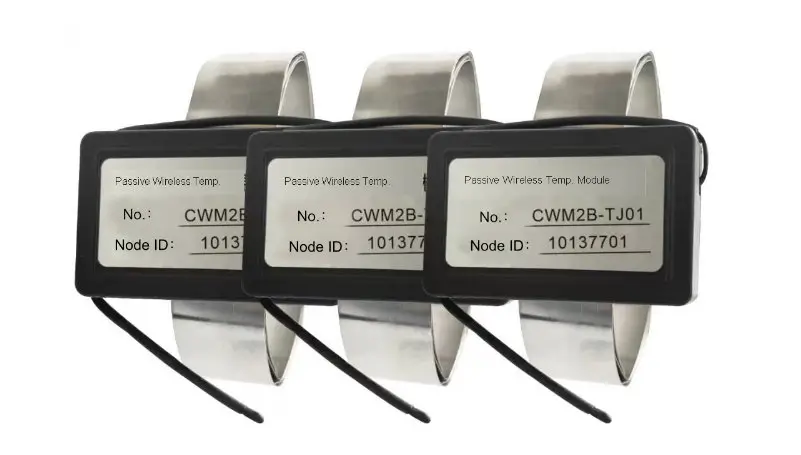
Switchgear temperature sensors, often referred to as wireless temperature sensors, are devices used for the online monitoring of temperatures within switchgear. These sensors can be installed at critical points prone to overheating, such as busbar joints, circuit breaker contacts, and cable connections.
They utilize wireless data transmission technology to periodically report temperature data; this data is collected by a receiving unit and subsequently uploaded to a local display unit or a remote monitoring system. As the sensors themselves require no signal wiring, they are easy to install, effectively reducing both installation costs and the complexity of future maintenance. This article introduces four commonly used wireless temperature sensors.
4 Types of Switchgear Temperature Sensors
Active Strap-Style Wireless Temperature Sensor
This industrial wireless temperature sensor features a colored nylon strap design and is powered by a built-in lithium battery; it operates as an active wireless temperature sensor. It attaches directly via the strap to busbar connection points, circuit breaker contacts, and cable joints. It does not rely on CT-based power harvesting, meaning it is unaffected by primary circuit current levels and ensures stable temperature measurement even under low-current conditions. Reporting intervals are configurable, and response times are rapid. This switchgear thermal monitoring is suitable for monitoring busbars and contacts temperature within switchgear cabinets.
Passive Strap-Style Wireless Temperature Sensor
Powered passively via CT (current transformer) harvesting—eliminating the need for batteries—it derives operating energy from the alternating magnetic field of the primary circuit. It utilizes a stainless steel strap for secure fastening and high/low-temperature resistance, making it ideal for long-term online monitoring of high-voltage switchgear busbars and high-current contacts.
Passive Wireless Temperature Sensor with External Probe
This wireless industrial temperature sensor features a design where the power harvesting module and the temperature probe are separate, connected by a lead wire. The switchgear temperature sensor body is positioned away from areas of high heat or strong electric fields, while the probe attaches directly to the specific hotspot being monitored. Suitable for locations with limited space, extremely high localized temperatures, or where direct mounting of the sensor body is impractical-such as on circuit breaker moving/fixed contacts or bushing connections. The probe allows for flexible wiring to accommodate complex installation environments; it also relies on primary circuit current for passive power harvesting.
Miniature Passive Wireless Temperature Sensor
A miniaturized, passive CT-powered sensor featuring a compact design and stainless steel strap mounting. Specifically engineered for installation points with limited space inside switchgear, such as compact withdrawable switchgear (e.g., KYN28 types) or busbar connections in ring main units (RMUs). Its small size ensures it does not encroach upon insulation clearances, thereby avoiding risks to phase-to-phase insulation; it operates passively without the need for batteries.
Conclusion
Selecting the right wireless temperature sensor depends on the switchgear structure, installation space, monitoring points, and primary circuit current conditions. From active battery-powered designs to passive CT-powered models, each type offers specific advantages for different applications. By choosing a suitable sensor, operators can improve the effectiveness of online temperature monitoring, identify potential overheating risks early, and enhance the safety and reliability of switchgear operation.
Chongqing Blue Jay Technology Co., Ltd. was founded by engineers with 10+ years of experience. Focuses on the development, production and sales of power automation monitoring products and energy metering instruments.